

A few weeks ago the internet announced it was left-hander’s day and, predictably, people came out with articles about how difficult it was being left-handed ‘Boo, scissors are wrong’ etc. There was very little about how left-handers are depicted (and not depicted) in fiction, which is a personal bugbear of mine. In a curious way, being left-handed gives you a glimpse into what being a minority is like and what being disabled is like. This is both trivial and non-trivial.
It is trivial in that being in the left-handed minority isn’t going to get you killed or arrested or treated to abuse or violence from strangers as is the case for many minorities in many parts of the world (although it wasn’t so long ago it lead to beatings in the British school system). Likewise, contrary to those articles being left-handed in a right-handed world is not a major adjustment – we do possess right hands as well and are often quite adept with them.
Where it is non-trivial is it gives a flavour of how the world reacts to difference and diversity. For many writers at the moment this is a big topic and writers of fantasy are by no means exempt from these concerns. The way difference is treated in fiction usually falls into three forms; representation, tokenism and diversity. Thus through the lens of left-handedness and the minor insights it gives, I shall attempt to approach the topic as a whole.
 Representation
At times, I’ve been sceptical about the notion of the need for representation. What is this narcissistic need readers and viewers are deemed to have that they need to see themselves in everything? American film producers are often the prime culprits of this and, I think, underestimate their audiences in doing so. They wanted to make Harry Potter American in the films. Fortunately, JK Rowling vetoed that and lo and behold American audiences still were able to enjoy it.
Similarly, I watch a lot of American TV and films and don’t spend the whole time waiting for a British person to turn up. When I read ‘The Famished Road’ I didn’t scour through the novel hoping that a white person would appear. I expect the people who populate a particular story to be consistent with that setting and don’t need to see ‘myself'(myself being someone who shares some identity position).
There’s an easy rejoinder to this point of view, however. That’s ok for you to say when you’re in the majority and have any number of representatives in fiction. There’s a measure of truth in that which only comes into focus when you’re not in the majority. Here’s where I return to left handers.
How many left-handed heroes are there in fantasy? Off the top of my head, Tolkien has one, Maedhros, who after having his right hand removed goes on to be better with a sword in his left hand. George RR Martin does a similar thing with Jaime Lannister only he is awful with his left hand. In fairness to Martin, I believe Ayra is mentioned as being left-handed making her the only example I can easily recall. I haven’t read the majority of fantasy fiction novels ever written so it is possible there are many others but I think my sample is large enough to be indicative.
Why so few? Here comes the explanation that is most often given for the absence of diversity – realism or, more properly, verisimilitude. Lets now create our fantasy world. I’m not going to say what is right and wrong for writers here (with one exception), rather pose the questions. And yes, left-handedness can obviously be substituted for other things.
First question? Is left-handedness as common in your fantasy world as ours? If it is then something like one in ten of your characters should be naturally lefty. Are they wielding their weapon left-handed? If not, why not? In many historical cultures there had been prejudice against left-handedness and lefties were forced to do things right-handed. The Romans were possibly the worst offenders for this. Putting aside the general cultural aspect of this intolerance for a moment, what function does this prejudice have? The Romans were keen on close formation fighting and had square shields for much of their Empire. Holding a spear left-handed and shield on the right arm would create a weak point in the line exposing the man on the left and shielding the shield of the man on the right. Getting rid of the lefty seems like a sensible course in this context.
Is this the only solution? Some hoplite shields from a similar time in history were notched on either side so the spear could be thrust through left or right-handed. Another option would be to put the lefty on the end of line (or block if fighting in squares). Does your culture care enough about the exceptions to make these adjustments?
If, on the other hand, your fantasy culture doesn’t fight in close formation like the Romans, for example forest skirmishers, the imperative for everyone to fight from the same direction disappears. In general, in a world where the majority fight right-handed, being left-handed is an advantage. Therefore, if it doesn’t undermine a formation, it would disadvantageous to force your fighters to suppress their natural preference. You may still wish to insist on this but then you need to bring in issues of intolerance rather than practicality to explain it.
I suspect lack of representation of left-handedness in fantasy broadly stems from two sources. One, the writer is themselves right-handed and has never given it any thought and two, their fantasy cultures are largely reminiscent of historical Earth cultures and transplant their attitudes to left-handedness into the bargain. There’s nothing inherently wrong with this latter position but would it hurt to put in an occasional reference such as the character having a stronger shield hand than normal? Just as a note, if you do decide to make that reference don’t make it that the character is a liability or cack-handed. We get enough of that crap already (and it’s almost always untrue).
Tokenism
Tokenism is different from issues of representation in that in this example the writer/screenwriter has made an effort to include or make reference to the minority but has done so in a way that is shallow or unhelpful. If there’s one thing worse than being represented it’s being represented in a way that negatively stereotypes. Frankly, I’d rather there weren’t any more British characters on American TV than have another effete aristocrat speaking like they’ve walked out of the 1920s show up. Or football hooligans either. There are plenty (I dare say the overwhelming majority) of British people who are neither of these things.
Left-handers fare no better. When do we get a mention? In crime stories, of course. Left-handedness is used as a gimmick to help catch the killer, the killer almost always being left-handed in these cases. Dammit, my sinister plan ruined by my sinister hand. The only other example I can bring to mind is an episode of CSI where Grissom concludes that the victim’s work space has been interfered with because the mouse was on the right hand side. The episode then goes on to helpfully inform us of the many left-handed Amercians who die every year using equipment the wrong way round. Sorry, Grissom and your great detective skills but I don’t know any left-handed people who have the mouse on the left-hand side (see earlier point about being able to use our right hands). Another classic is which wrist the watch was on not matching handedness. It doesn’t? Maybe that’s because people don’t always follow that rule.
The problem with tokenism is that is rarely has a function beyond merely acknowledging the existence of a group. Little to no attempt is made to integrate that aspect of the person in a wider character or even to suggest they have a character beyond that particular aspect. In the case of lefties we are boiled down to murderers and being unable to adapt to a right-handed world, which ironically is actually something we’re generally pretty good at (the functioning not the murder although I’m sure we’d do a great job of that too if we put our lateral-thinking minds to it).
 Diversity
How do you represent and get beyond tokenism? I think the major pointer here is about your motivation for including difference in your story. If you are including difference because you feel you ought to and it will make someone happy then it’s probably going to be a struggle to pass through tokenism because in essence that’s what you’re doing.
The most compelling reason I can think of to include difference and diversity in a story is that it is simply a better story and richer world for doing so. We don’t want to travel to a place that is the same as the one we left. We don’t want every new person to look and think exactly the same as the ones we already know. We wouldn’t survive as a species if everyone was attracted to one type of person.
In the case of left-handers, I think this works on an aesthetic and interest level. In sports, I always like the look of seeing a left-handed tennis player against a right-handed one or the field and tactics in cricket having to be readjusted for the left-handed batsman coming in. This can easily be transposed into fiction; the challenges of facing a left-hander in a duel or the particular advantage for a lefty fighting up a spiral staircase.
Left-handedness, like any difference, brings a new set of challenges and story-telling opportunities. As writers these are gifts that we should relish. Instead of contemplating how to bring diversity into our stories we should use diversity as a starting point and be grateful for the layers of complexity it provides.

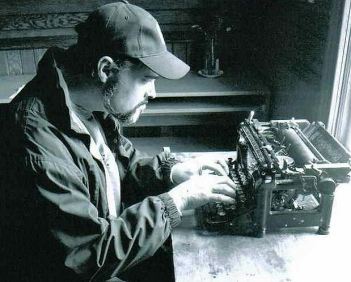 Think of a writer at work, go on…What’s the first image that comes to mind? It might be a man or woman, more probably a man because on film and TV (contrary to reality) writers are almost always male – female writers are usually journalists or diarists, and they will be huddled over a typewriter furiously tearing away unwanted pages and throwing them in the bin until the manuscript arrives as a neat stack.
 This may be a controversial one because I’m sure writers do frequent cafes and do write things down there. In my experience, however, cafes are far too busy, noisy and distracting to get deeply into a novel in those surroundings. Making notes? Doable. Writing a blog? Sure. Putting in the hard grind? I’m less convinced but I accept that others may be better at blocking out the distractions than me. Likewise, they may not be bothered by paying for all those drinks and eating out twice a day. For me that’s an unnecessary expense.
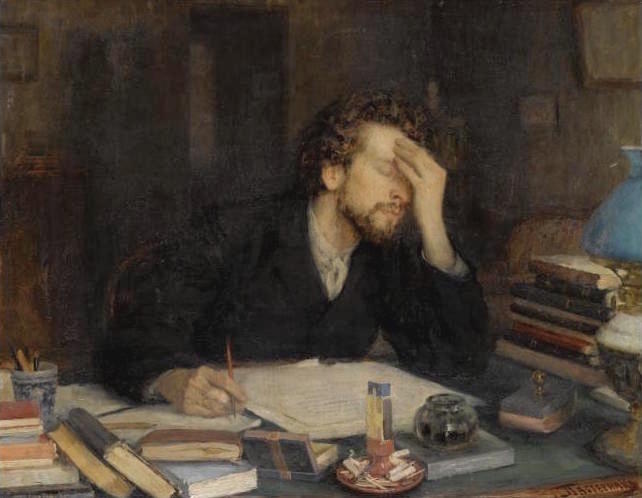
 On that subject, fiction has a lot to answer for too. In popular culture writers have two modes: inspired and blocked. The truth is that the majority of the time they will be somewhere between the two. This is inevitable. Writing 100,000 words plus takes time and if you only wrote when inspired you’d never get to the end.
 When you tell people you’re a writer there are some questions that almost always get asked. The most annoying is ‘do you have a publisher?’, not because of the question in of itself but the reaction to anyone who says no. That ‘ohh’ with declining intonation and the subsequent changing of topic is well-known code for ‘so you’re not really a writer then?’ Musicians don’t get this reaction when they say they’re not signed to a major record label yet.
 Equally, some chapters are more difficult than others. I get chapter block far more often than full-on writer’s block. I can always write something just not always where I need to write it. Those 300 words you bled to get out may be the ones that bring a breakthrough and get you to a part of the story where the flow becomes much easier again. They are the chiselling that produces cracks in the wall of inertia.

 Nexus-Fiction